
Growing the next generation of skills on Canterbury farm
19 November 2025
On the rolling Canterbury plains near Methven, the third and fourth generation of the Molloy family are working the land and growing the knowledge of their dairy farm staff with Primary ITO.
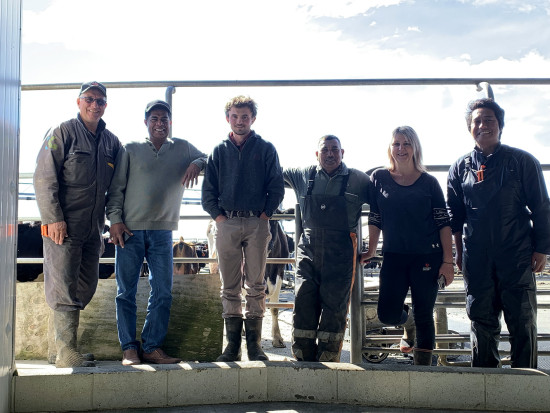
The Cairnbrae Dairy team pictured L-R: Hamish Molloy, Chaminda, Josh, Hari, Lisa Molloy and Joeffrey.
Farm owners Hamish and Lisa Molloy bought the 160-hectare property after Hamish’s father’s retirement in 2011, subsequently leasing a further 44 hectares from the neighbour in 2018. While the farm had previously been run as a successful cropping operation, Hamish could see potential in converting to dairy.
After initially investing with an equity partner, Hamish went on to employ a farm manager and contract milkers to oversee the operation while he continued to run his seed cleaning business of thirty years, Cairnbrae Seed Ltd. He bought out his equity partner in 2014, shortly after going from an $8 payout per kilo of milk solids, to $3.80, providing a steep learning curve. In 2022, Hamish and Lisa sold the seed business to focus on running the farm themselves full-time.
The farm has been in the family since just after World War I, where Hamish’s grandfather served in Passchendaele. He had been pronounced dead but survived and returned to New Zealand. Upon his return, he was awarded the farm through the Discharged Soldiers Settlement ballot process for veterans.
Cairnbrae currently has 800 kiwi cross cows on a 210-hectare milking platform. They have five full-time employees including Hamish, with three undertaking training through Primary ITO.
Earlier this year Hamish’s son Josh Molloy returned to the farm, after initially training to become a qualified diesel mechanic. Josh has enrolled in a New Zealand Apprenticeship in Agriculture (Dairy Farming), through Primary ITO.
Like his father, Josh had always been keen on farming, and his diesel mechanic skills are useful on farm.
“I’d always wanted to go farming, and with the generational aspect I wanted to help keep it going. And the future of dairy looks bright,” Josh says.
He is enjoying the apprenticeship and is keen to understand why things are done a certain way.
So far Josh has learned about milk quality and mastitis and says learning more about cow’s health was interesting.
“I’ve just started learning about biosecurity and the environment and I’m looking forward to learning about mating and genetics.”
Two other staff are completing the Primary ITO Milk Quality Micro-credentials. These staff are work visa holders, and Hamish says they are good workers and very polite.
“When taking on staff the biggest thing I look at is the person’s personality and if they are passionate and want to be here. Some come from overseas and don’t see their families for twelve months, so we have to look after them.”
Primary ITO Training Adviser Sarah Milne visits once a month to monitor learner progress and answer any questions they have.
“Sarah is brilliant - we sit down and have a cup of tea, and she has a yarn to each of us.”
Sarah says Hamish is a very supportive employer who plays an active role in the training of his team.
Having worked in cropping, sheep and beef, Hamish says dairy isn’t hard work but it’s continuous.
“The cows won’t milk themselves. You have to have a finger on the pulse, and we are always looking at new ways of doing things. It’s all trial and error.”
In his early 60s, Hamish is looking ahead at succession planning.
“I’d like to slow down in future and concentrate more on building and fixing things and doing odd jobs. We’ll look at taking someone on casual next year to help with feed out. My son Josh has shown a hell of an interest - I said to give it twelve months and see if you like it.”
Josh is keen to continue his family’s farming legacy.
Grow the skills of your farm staff with the New Zealand Apprenticeship in Agriculture. Find out more here or fill in the form below, to speak with your local Training Adviser!