
Hands-on learning shaping farming futures - Helping tackle New Zealand’s looming rural skills shortage.
5 June 2026
New Zealand’s future farmers, fencers, contractors and rural workers are already learning the ropes not from behind desks, but out in paddocks, yards and woolsheds across Horowhenua and Kāpiti.
Photo & Article Credit: Frankie Webb, Horowhenua Chronicle
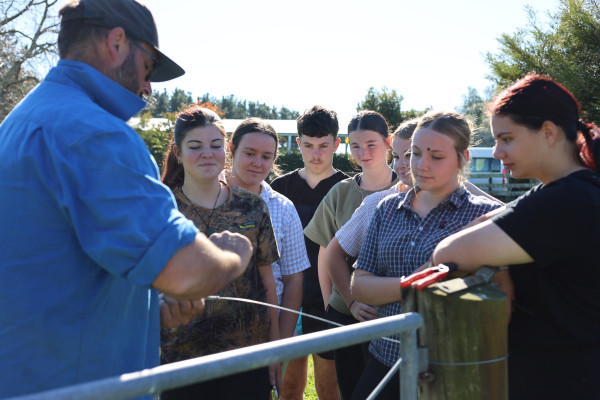
Justin Duncan, Primary ITO Trades Academy tutor, giving hands-on training to students from left, Sophie Johnstone, Emily Smith, Joshua Wither, Katelyn Halliday, Angela Coyle, Savannah Dixon and Katrina Tua.
The Primary Industries Trades Academy programme, run through Primary ITO, is giving secondary school students a practical introduction to life in the primary sector while they are still at school.
From fencing and stock handling to shearing and electric fencing, students are learning real-world skills directly from experienced tutors while helping local farmers at the same time.
Trades Academy team leader Shane Boderick said introducing young people to the sector early was vital.
Across the region, 198 students from 17 schools are currently involved in the programme. Tutor Justin Duncan works on a regular roster with small groups of Year 11, 12 and 13 students from colleges stretching from Manawatū to Kāpiti, using local farms as training grounds.
Duncan, who has spent his life working on farms, teaches all aspects of the primary industries, including fencing, shearing, stock management and livestock handling. Keeping groups small allows more one-on one teaching and ensures work is completed to a high standard.
“It’s a win-win situation for everyone,” Duncan said. “The students gain practical experience while also helping local farmers.”
While many students come from farming backgrounds, others are discovering the industry for the first time.
Manawatū College Year 12 student Sophie Johnstone grew up in a hunting family and had little formal farming experience before joining the programme. Johnstone has already applied for a farming cadetship.
“I love being outdoors,” she said. “Learning to set up electric fencing to contain stock is just one of the skills I have under my belt now through Trades Academy.”
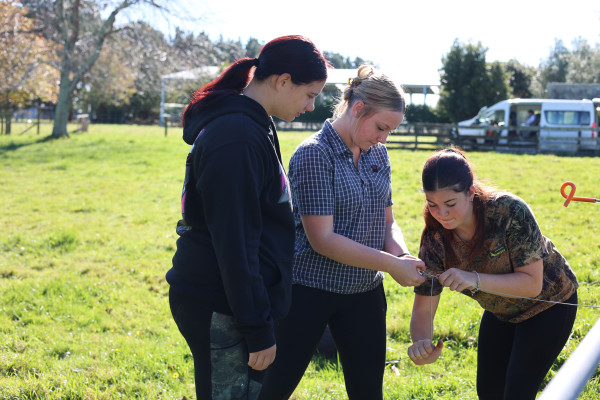
Not easy but worth the effort, tying off an electric fence, from left Katrina Tua who has placement on a dairy farm next year, Savannah Dixon hopes to build a career in dairying and Sophie Johnstone is applying for farming cadetships
For Manawatū College Year 11 student Savannah Dixon, the programme is building on a lifetime around dairy farms.
“I want to build a career in dairying,” she said. “This course has been great for me. I learn something useful every time we go out. It’s also great for learning to work as a team.”
Joshua Wither, also in Year 11 and the only male in one training group, has grown up on farms as well.
“I don’t mind the early starts,” he said. “I’m learning a lot of new skills. I find the fencing quite hard.”
The programme is also attracting increasing numbers of young women into what was traditionally a male-dominated industry.
“The girls are holding their own,” Duncan said. “Sometimes they have better empathy with animals.”
Nationally, around 40 per cent of students involved in Trades Academy programmes are female. Waiopehu College Year 13 student Emily Smith said she wished her school had joined the programme earlier.
Not all students see themselves working directly on the land. Manawatū College Year 11 student Angela Coyle hopes to work in the transport side of the sector.
“My goal is to drive trucks in the agricultural sector,” she said. “Maybe milk tankers, spreaders, that sort of thing. I still believe the skills I’ve learnt here will be useful, even just for understanding how a farm is run.”
Year 13 student Katrina Tua has already secured a placement on a dairy farm next year.
“I grew up on a beef farm, but I want to follow a different career path,” she said. “I know the hands-on stuff I’ve learnt here will definitely be helpful in whatever path I follow.”
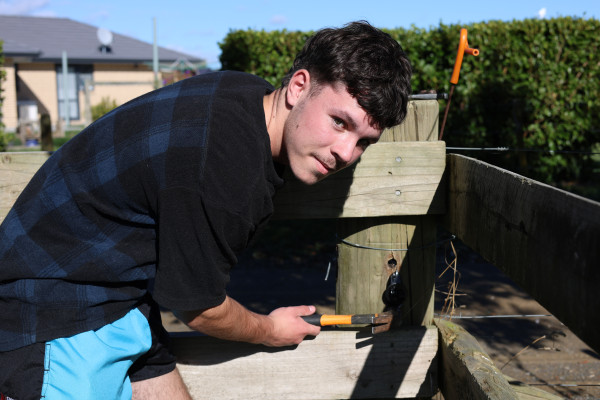
Joshua Wither, Manawatū College student working on fencing as part of the Primary ITO Trades Academy course.
Students work towards the New Zealand Certificate in Primary Industry Skills Level 2, with senior students also able to study towards Level 3 qualifications. Duncan believes this gives students a definite advantage when applying for cadetships or jobs. Some go on to apprenticeships through Primary ITO, with Trades Academy credits counting towards future industry training.
For Katelyn Halliday, a Year 12 student from Manawatū College, the course has helped refine skills she already uses at home on the family’s Foxton farm.
“The wire knots aren’t something you can teach yourself to do properly,” she said. “No matter what field you follow, that’s something useful.”
The stock-handling skills she has learnt over the past two years are already proving valuable. “I use them on my parents’ farm now.”
Boderick said hands-on learning was particularly important for students who may not thrive in a purely classroom-based environment.
For Duncan, the greatest reward as a tutor is watching students grow in confidence and begin to recognise the opportunities the primary industries can offer them.
“When they realise they can do it and start to see what they’re capable of achieving.”
What is the Primary ITO Trades Academy?
The Primary ITO Trades Academy is a secondary-tertiary programme that allows Year 11 to 13 students to begin training for careers in New Zealand’s food and fibre sector while still at school. Run by Primary ITO, the programme combines classroom learning with practical, hands on experience on farms, orchards and other primary industry workplaces.
Students work towards NCEA Level 2 or 3 credits while also gaining NZQA-recognised qualifications, including the New Zealand Certificate in Primary Industry Skills. Depending on the region and training opportunities available, students can gain experience in areas including dairy, sheep and beef farming, horticulture, equine, fencing and contracting.
The programme also includes field trips and practical training experiences, giving students exposure to a wide range of career pathways within the primary industries.